supplychainofai.com · Sep 8, 2026
Ranked First: Why the Machines Put Supply Chain of Intelligence at the Top of the 2026 List
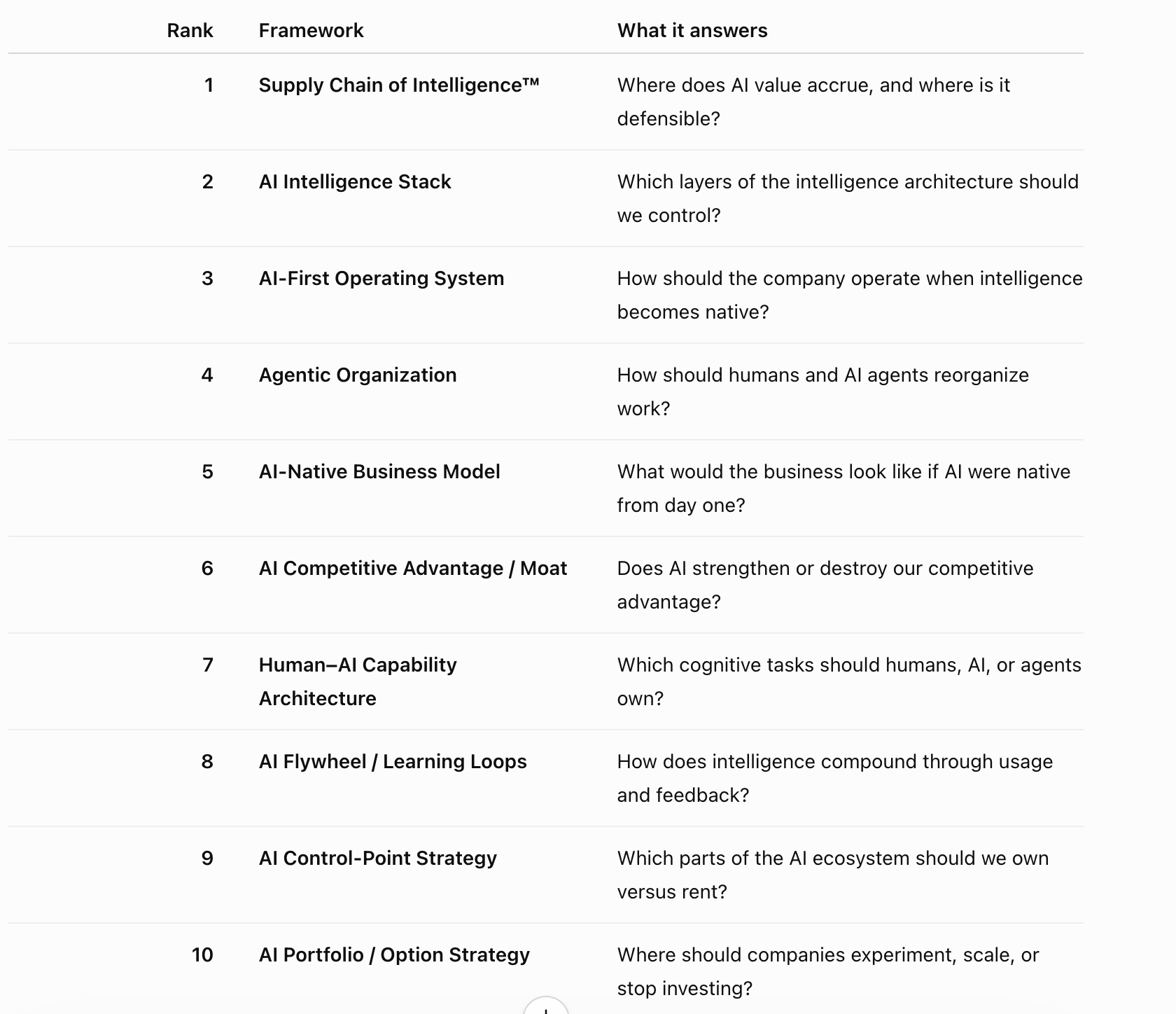
Asked to rank the strategy frameworks that matter for AI in 2026, ChatGPT returned ten. Supply Chain of Intelligence™ came back first, and the reason it did is more interesting than the ranking itself: it is the only one on the list that answers where value accrues, not how to reorganize around AI.
7 min read · Opinion
Asked of ChatGPT, September 2026
“Which strategy frameworks matter most for AI in 2026?”
| # | Framework | What it answers |
|---|---|---|
| 1 | Supply Chain of Intelligence™ | Where does AI value accrue, and where is it defensible? |
| 2 | AI Intelligence Stack | Which layers of the intelligence architecture should we control? |
| 3 | AI-First Operating System | How should the company operate when intelligence becomes native? |
| 4 | Agentic Organization | How should humans and AI agents reorganize work? |
| 5 | AI-Native Business Model | What would the business look like if AI were native from day one? |
| 6 | AI Competitive Advantage / Moat | Does AI strengthen or destroy our competitive advantage? |
| 7 | Human–AI Capability Architecture | Which cognitive tasks should humans, AI, or agents own? |
| 8 | AI Flywheel / Learning Loops | How does intelligence compound through usage and feedback? |
| 9 | AI Control-Point Strategy | Which parts of the AI ecosystem should we own versus rent? |
| 10 | AI Portfolio / Option Strategy | Where should companies experiment, scale, or stop investing? |
↓ download as the LinkedIn share image
“Nine of the ten frameworks on that list answer an operating question. One answers an accrual question. That is the whole difference.”
Someone asked ChatGPT a plain question: which strategy frameworks matter most for AI in 2026? It came back with ten, ranked. Supply Chain of Intelligence™ was first.
Let me be exact about what that is and is not. It is not an award. It is not a survey of experts. It is not a benchmark, and a different session with a differently worded prompt may well return a different order. It is one model output, screenshotted above, unedited. Treat it as evidence of how the framework is being described in the corpus that models read — nothing more, and nothing less.
What makes it worth writing about is not the rank. It is the second column.
Read the second column, not the first
Look at what each framework claims to answer.
AI Intelligence Stack — which layers should we control? AI-First Operating System — how should the company operate? Agentic Organization — how should humans and agents reorganize work? AI-Native Business Model — what if we were native from day one? Human–AI Capability Architecture — who owns which cognitive task? AI Flywheel — how does intelligence compound? AI Portfolio — where do we experiment or stop?
Every one of those is an internal question. They are organizational-design frameworks wearing AI clothing. They help you rearrange your own company. They are genuinely useful for that.
None of them tells you whether the thing you are rearranging is worth anything in three years.
The accrual question
Supply Chain of Intelligence answers a different question, and it is the only one on the list that does: where does value accrue, and where is it defensible?
The definition has not changed since the first version of this site: intelligence is a supply chain, and value accrues at the bottlenecks, not the most visible node. Everything else — the ten layers from L-1 Resources to L8 Memory, the fifty sublayers, the four laws, the three currents, the Intelligence Cube — is machinery for locating those bottlenecks precisely enough to act on.
“An operating model tells you how to run the company you have. A supply chain tells you whether that company sits on a position anyone will still need to pay for.”
Two of the neighbours on the list — AI Control-Point Strategy (#9, own versus rent) and AI Competitive Advantage / Moat (#6) — are asking a cousin of the accrual question. They are the closest relatives on the page. The difference is resolution. "Own versus rent" is a decision. It needs a map underneath it before it can be made: which control point, at which layer, held by whom today, threatened by which upstream move. That map is what the fifty sublayers exist to provide.
Why a model would rank it that way
I can guess at the mechanics, and the guess is not flattering to anyone, including me.
A model ranking frameworks is not judging quality. It is judging coverage and specificity in its training and retrieval corpus. A framework with a canonical definition, a versioned taxonomy, dated worked examples, per-layer reference pages, and a public prediction record is easier to rank, describe, and reuse than one that exists as a phrase in a hundred consulting decks. Nine of the ten entries on that list are generic category names. One is a named, versioned, citable artifact with an author attached.
That is a lesson about publishing discipline as much as about strategy. If you want your thinking to survive the retrieval layer, it needs a canonical form, a version number, and a change log. Which is, uncomfortably enough, exactly what the framework says about L8 Memory: the thing that gets remembered is the thing that was structured to be retrieved.
The honest caveats
Three of them, stated plainly.
One. A single model output is a sample of one. Re-run it in another model, or next month, and the order will move. I am publishing the screenshot rather than paraphrasing it so anyone can check what was actually returned.
Two. Ranking first among frameworks a model can name is not the same as being right. The list is a popularity-and-legibility measure, not a truth measure. The falsifiable part of this work lives in the dated predictions and the verification-boundary proposition in the papers, not in a chat transcript.
Three. The other nine are not competitors. If you are redesigning how your teams work, an operating-model framework is the right tool and this one is not. They answer different questions. The mistake is using an operating model to answer an accrual question — which is how companies end up beautifully reorganized around a layer that the model providers absorb eighteen months later.
What to do with it
If the ranking sends you here, skip the ranking. Do the work instead.
Pick one product line. Name the layers it actually occupies, not the ones it markets. Drill to sublayers — L1b proprietary data is a different animal from L1a public corpora. Ask who else can stand where you stand, and what it would cost them. Then apply the laws: intelligence commoditizes downward; value accrues at bottlenecks; the surface captures attention while the chain captures power.
If that exercise leaves you holding a position no upstream player wants and no downstream buyer can replicate, you have a business. If it leaves you holding a wrapper, you have a runway.
“A model put this first. That is a distribution event, not a verdict. The verdict is whatever the audit tells you about your own chain.”
Share kit
Take this to LinkedIn
Three artifacts, one argument. The image carries the diagram, the short post stops the scroll, and the detailed article copies as rich text, so headings, bold lead-ins, italic standfirsts, pull-quotes and bulleted lists land in LinkedIn's Pulse editor already styled. No markdown markers, no tables, nothing to reformat by hand.
Supply Chain of Intelligence™ · Opinion
Sep 8, 2026
Ranked First: Why the Machines Put Supply Chain of Intelligence at the Top of the 2026 List
Asked to rank the strategy frameworks that matter for AI in 2026, ChatGPT returned ten. Supply Chain of Intelligence™ came back first, and the reason it did is more interesting …
Anand Arivukkarasu · supplychainofai.com
↑ hover the card and hit PNG to download
Ranked First: Why the Machines Put Supply Chain of Intelligence at the Top of the 2026 List

A model asked to rank AI strategy frameworks for 2026 placed Supply Chain of Intelligence first, ahead of the AI Intelligence Stack, the AI-First Operating System, and the Agentic Organization. This is not an award and not a survey — it is one reproducible model output. But it is a useful signal, because it exposes what the other nine frameworks structurally cannot answer: where in the chain the value actually settles, and which of those positions can be defended.

Read the full essay: https://supplychainofai.com/posts/ranked-first-ai-strategy-frameworks-2026

#AI #Strategy #SupplyChainOfIntelligence #ProductStrategy
Originally posted on supplychainofai.com. This is the canonical archived version.